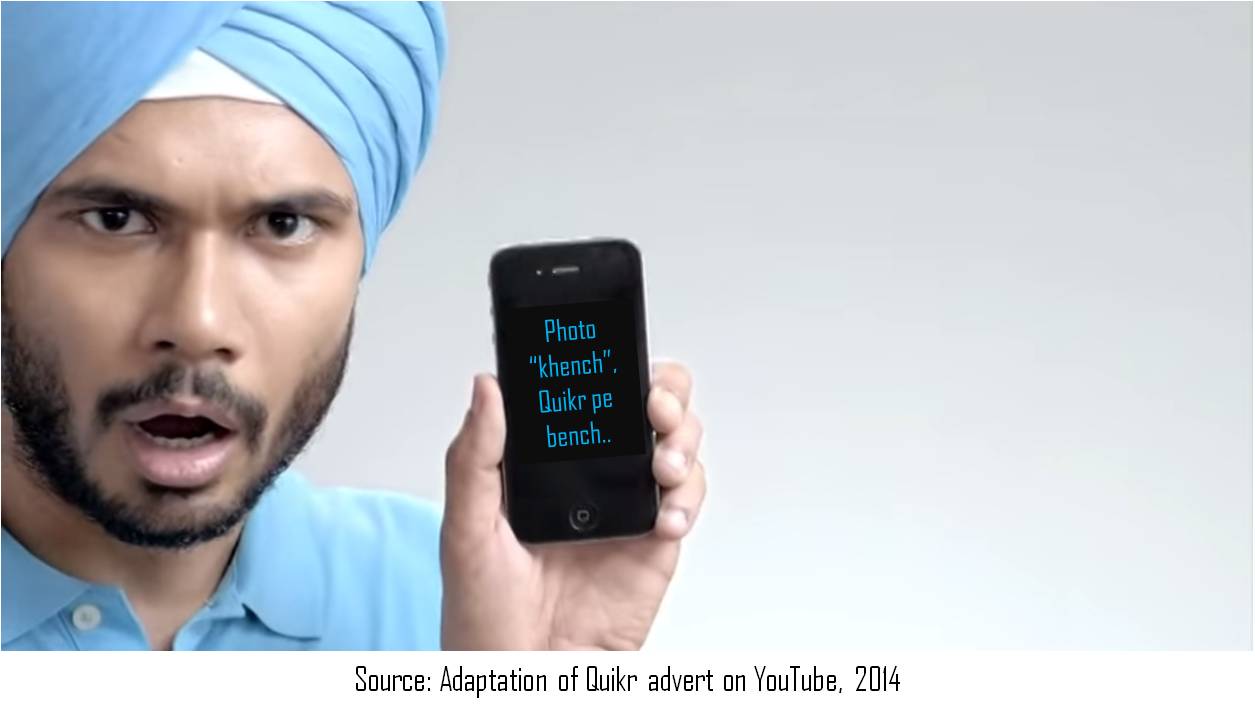

By now, most Indians must have seen the new Quikr advertisement on several television as well as radio channels. Quikr is a web platform for the local community (individual buyers and sellers included) to connect and trade. Their tagline in the ad is “Photo khench, Quikr pe bench” which when simplistically translated means, “click a picture to sell the object.” What is curious is their use of the Hindi word “khinch” which means ‘to click’ and pronouncing it as “khench” which is not a Hindi word, so that it rhymes with “bench” which means ‘to sell”.
Unlike English, language in India is differentiable not only across various geographic regions, religions, and cultures but also across many other mind numbing parameters. Despite Hindi being the national language, it may or may not be written, spoken, or taught in a similar fashion across the nation. Therefore, one tends to come across several new words in his/her daily life despite being familiar with the language, or even having mastered it. This also means that similar words tend to have different pronunciations which could get confusing for some people or in this case, help a brand connect with their local community with a smart rhyming jingle.
A recent research suggested that brands are trying various ways to differentiate themselves in the heavily crowded e-commerce segment. It is predominantly a fight to lower the costs associated with the buy side of the e-commerce business, as customer loyalty tends to be fickle in such an infant segment. Also the popular opinion that majority of this customer base comes from tier-I cities has been disproven. Currently, about 60% revenue is being generated from tier-II and tier-III cities for the big players in this category. This therefore, puts language in the forefront of all branding and advertising campaigns, as a linguistically disconnected brand message can tend to alienate the local target market. Language and localization along with mobilization of technology means additional hurdles for an e-commerce brand while designing interactive applications and platforms that these regional customers will use. The ads of Quikr as well as competitors also depict the use of smart phones while interacting with the brands. How then, should a brand design an advertising message, that uses the local lingo, reaches the local community who can easily decipher it, does not alienate the surrounding target market and does not lead to misinterpretations.
A purist view will debate about the misuse of language in such cases no doubt, but hasn’t the country already crossed over that bridge with social media? India stands as the second largest user of Twitter and Facebook and the country is also the largest user of Whatsapp. Our language therefore, and correctly so, has gone for a toss. We have seen language influencing branding and communication over the years. Are we about to see its effect the other way around?
***
Tanmay Muthe is a Business Consultant with projects in various domains like Technology, Finance, Retail and Education. His expertise lies in the retail domain specializing in business strategy and tech facilitation. He has been a liaison between culturally and geographically diverse teams while designing customized business solutions for clients.
Disclaimer: The views expressed in this article are solely those of the author and do not in any way reflect the opinions of his employer or clients.
 mrtanmay.com
We see enactments of stereotypes regularly in Bollywood where language plays a big part of the character. ‘Punjabi uncle’ was a popular one for many years, set with his turban & clothes, often a big belly, funny dad-jokes, love for food/alcohol, and overall joyful demeanour… and of course, language. In movies and media we’ve had tons of these… like the ‘Gujurati business man’ archetype (with his chains, rings, off-white shirt with 1 button open, and sometimes sunglasses when they’re not required), the ‘over-smart millennial’ archetype (wears graphic tees, has headphones around his neck, throws around slang and texting language IRL, with the typical wannabe-American accent but really from Bombay), the distinctive ‘Bihari person’ (dialect and accent is everything). I think they’ve been used comically for decades, and idk how I feel about that, but in a country like India, so large and varied in culture and languages (and their 3840278 dialects), we’re bound to experience a sense of isolation in terms of nationalized media (like the ads you mentioned) that are really meant more for a localized audience than a national one that may not all relate.
LikeLiked by 1 person